Tyre Couplings
Rokee is a manufacturer of tyre couplings from china, we can provide non-standard custom tyre couplings based on parameters or drawings supplied by customers, with export support available.
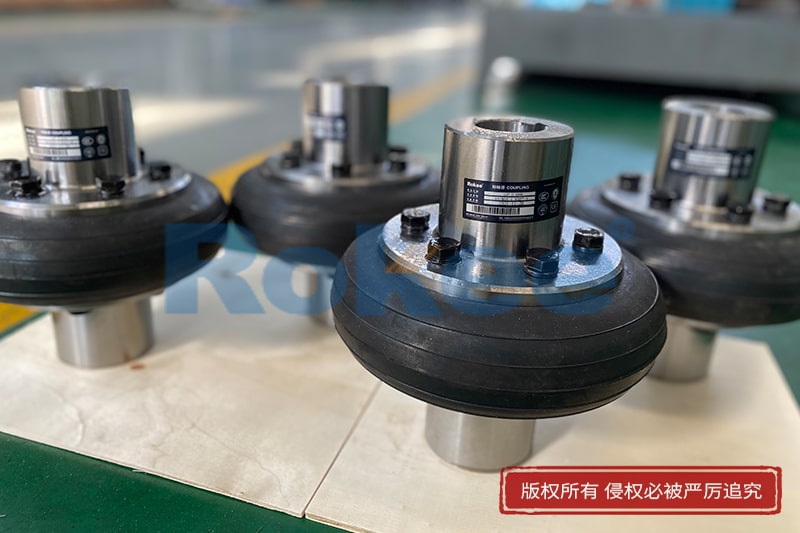
In the complex and interconnected system of modern industrial mechanical transmission, flexible coupling components serve as indispensable core connecting units between power sources and execution equipment. Among numerous coupling types, tyre coupling stands out with its unique elastic structure, excellent misalignment compensation capability and superior vibration damping performance, becoming a key basic component that balances stable power transmission, equipment protection and long-term operational reliability. As a typical elastomeric flexible transmission part, it has been widely deployed in light and heavy industrial scenarios, adapting to diverse working conditions from low-speed stable operation to high-frequency impact load operation, and has gradually become a preferred connecting solution for medium and low torque transmission systems in various industries.
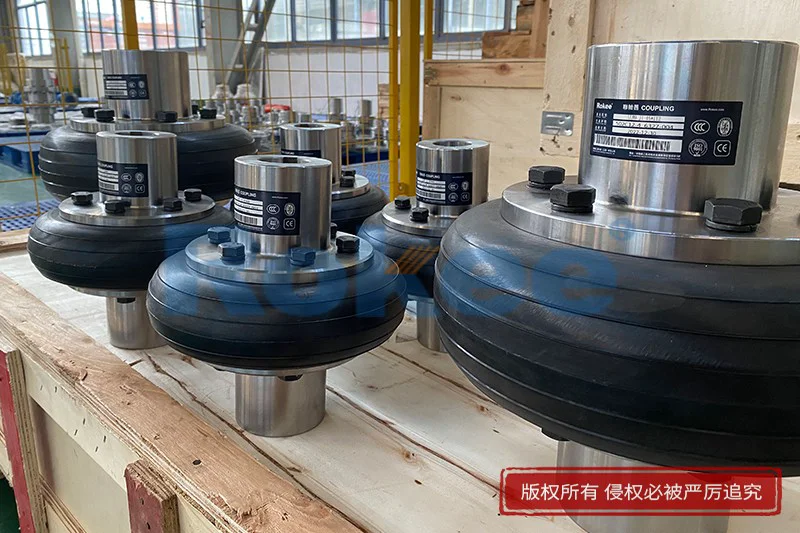


The basic structural composition of tyre coupling follows the design logic of flexible transmission, featuring a simple and robust overall structure without redundant mechanical parts. The core functional component is a tyre-shaped elastic rubber element, which is the key to realizing vibration absorption and displacement compensation. This elastic element is tightly bonded with metal flanges on both sides through professional vulcanization technology, forming an integrated transmission structure. The metal parts on both sides are connected to the driving shaft and driven shaft of mechanical equipment respectively, realizing continuous and efficient torque transmission in the operating state. Compared with rigid couplings that rely on hard contact for force transmission and lack adaptive buffer space, the structural design of tyre coupling fully retains the elastic deformation space of rubber materials, fundamentally solving the problems of rigid impact and stress concentration easily caused by rigid connection during equipment operation. Meanwhile, the overall structure eliminates complex transmission accessories, which lays a solid foundation for its convenient installation, simple daily maintenance and long service life in industrial applications.
The working principle of tyre coupling is based on the elastic deformation characteristics of high-performance rubber materials, realizing multiple functional values such as torque transmission, misalignment compensation, vibration damping and impact absorption in the mechanical operation process. In the normal working state of equipment, the elastic tyre element relies on its own torsional deformation to transmit torque stably between the driving end and the driven end, ensuring synchronous operation of the transmission system. In actual industrial working scenarios, due to machining errors of equipment parts, installation deviation, foundation settlement after long-term operation and thermal deformation of mechanical components during high-load operation, relative displacement is inevitable between the two connected shafts. Such displacement includes axial displacement generated by shaft telescoping, angular displacement formed by shaft inclination, and parallel offset displacement of the shaft centerline. The tyre coupling can effectively adapt to these three-dimensional misalignment states through the flexible deformation of the rubber tyre element. It will not generate additional mechanical stress on the shaft, bearing and other core components of the equipment due to shaft displacement, nor will it affect the continuity and stability of power transmission. This unique adaptive compensation ability makes up for the inherent defects of traditional rigid transmission components and greatly improves the fault tolerance of the transmission system.
In terms of vibration damping and shock absorption performance, tyre coupling shows unparalleled advantages in many working conditions. Most industrial mechanical equipment will produce periodic vibration during continuous operation, and frequent startup, shutdown and load mutation will also generate instantaneous impact loads. These vibrations and impact forces will be directly transmitted to various components of the equipment through the rigid transmission system, accelerating component wear, increasing equipment operating noise, and even inducing mechanical resonance in severe cases, which endangers the safe operation of the entire production line. The rubber elastic element of tyre coupling has excellent energy absorption characteristics, which can effectively absorb and buffer torsional vibration and mechanical impact generated in the transmission process. It can reduce the vibration amplitude of the transmission system, isolate vibration transmission between equipment components, and lower the overall operating noise of mechanical equipment. In addition, the low torsional stiffness characteristic of the tyre coupling can adjust the natural frequency of the transmission system, keeping the torsional natural frequency of the system outside the conventional operating speed range, thereby completely avoiding the resonance phenomenon that seriously damages equipment stability and service life. This vibration suppression mechanism is crucial for prolonging the service life of mechanical equipment and maintaining stable production operation.
The comprehensive performance advantages of tyre coupling are fully reflected in its practical industrial application characteristics, covering multiple dimensions of operational stability, environmental adaptability and economic applicability. First of all, it has extremely high operational stability and anti-fatigue ability. The specially formulated industrial rubber material has excellent tensile resistance, tear resistance and aging resistance. After special vulcanization treatment, the bonding strength between the rubber tyre and the metal flange is extremely high, and it is not easy to produce degumming, cracking and damage under long-term cyclic load and frequent deformation. It can maintain stable elastic performance and transmission accuracy for a long time, avoiding frequent equipment failures caused by coupling failure. Secondly, the tyre coupling has outstanding low-load starting performance. Its flexible transmission characteristic can effectively buffer the instantaneous starting torque of the equipment, avoid rigid impact on the motor and transmission components during equipment startup, reduce the starting load of the power source, and protect the motor and reducer from instantaneous overload damage. This performance is particularly suitable for mechanical equipment that needs frequent startup and intermittent operation.
In terms of daily operation and maintenance, tyre coupling has obvious economic and practical advantages different from other types of flexible couplings. Its simple integrated structure does not require lubricating oil, grease and other auxiliary lubricating materials during operation, completely eliminating the daily lubrication maintenance work required by gear couplings and chain couplings. This not only reduces the daily maintenance workload and labor cost of equipment, but also avoids equipment pollution and environmental pollution caused by lubricant leakage, meeting the clean production requirements of modern industrial production. At the same time, the overall structure is convenient for on-site installation, inspection and replacement. Operators can quickly complete installation and debugging work through conventional assembly tools, and the regular daily inspection only needs to check the surface state of the rubber tyre element and the fastening degree of the connecting parts, without complex detection equipment and professional technical operation. The low maintenance cost and simple operation mode make it very suitable for large-scale popularization and application in industrial production lines.
Tyre coupling also shows strong environmental adaptability and working condition tolerance. It can maintain stable working performance within a conventional temperature range, adapting to most indoor and outdoor industrial production environments. It has good corrosion resistance and aging resistance, and can resist the erosion of conventional humid air, dust and weak corrosive media in industrial workshops. For working conditions with slight foundation vibration and equipment displacement deviation, it can adapt automatically without affecting the normal operation of the equipment, reducing frequent shutdown maintenance caused by shaft misalignment. In addition, the tyre coupling has good buffering performance for variable load working conditions. Many industrial equipment will face frequent load changes during operation, and the elastic deformation of the rubber element can effectively buffer the load fluctuation, stabilize the transmission torque, and avoid unstable equipment operation caused by load mutation, thus improving the overall operation efficiency of the mechanical system.
Relying on the above comprehensive performance advantages, tyre coupling has been widely applied in multiple industrial fields, covering general machinery, engineering machinery, agricultural machinery, energy and chemical industry and many other scenarios. In the field of general industrial machinery, it is commonly used in power transmission systems of pumps, fans, compressors and conveyor equipment. These devices usually run continuously for a long time and have high requirements for operational stability and vibration control. The vibration damping and misalignment compensation performance of tyre coupling can effectively reduce the operating vibration of fans and pumps, avoid pipeline vibration and noise resonance caused by equipment vibration, and ensure the stable operation of fluid transmission systems. For conveyor equipment with long-term cyclic operation and variable load, it can buffer the impact load generated by material transportation and start-stop, protect the transmission shaft and bearing components, and reduce equipment failure rate.
In the field of engineering and mining machinery, tyre coupling is applied to hammer mills, pulverizers, mining conveyors and other heavy-load operation equipment. Such equipment often faces harsh working conditions such as heavy impact load, dusty environment and long-term continuous operation. The excellent shock absorption and anti-fatigue performance of tyre coupling can adapt to the impact load generated by material crushing and mining operation, avoid rapid wear of transmission components caused by rigid impact, and improve the durability of heavy-duty mechanical transmission systems. At the same time, its dust resistance and low maintenance characteristics can adapt to the harsh mining operation environment, reducing the downtime and maintenance frequency of mining equipment, and improving the continuous operation capacity of mining production lines.
In agricultural and marine industrial scenarios, the application value of tyre coupling is also fully reflected. Agricultural equipment such as tractors and combine harvesters often operates on uneven field roads, and the equipment will produce severe vibration and shaft displacement during operation. The good misalignment adaptability and vibration damping performance of tyre coupling can ensure stable power transmission of agricultural machinery under complex road conditions, improve the operating stability of field equipment, and reduce component wear caused by vibration. In marine equipment, it is used in partial shaft transmission systems of marine auxiliary equipment, adapting to the vibration and slight displacement generated by ship navigation, ensuring the stable operation of marine mechanical equipment, and improving the safety and reliability of marine power transmission.
In the chemical, building materials and energy industries, tyre coupling also plays an important role in supporting stable production. Mechanical equipment such as clay processing machinery, cement production equipment and power generation dynamometers has high requirements for transmission stability and equipment safety. The flexible transmission mode of tyre coupling can effectively isolate vibration between equipment units, avoid the spread of mechanical vibration affecting the operation accuracy of precision equipment, and prevent equipment damage and production safety accidents caused by excessive vibration. Its clean operation mode without lubricant leakage also meets the strict environmental protection and production safety requirements of chemical and building material industries, avoiding product pollution and safety hazards caused by lubricant leakage.
Although tyre coupling has comprehensive performance advantages, its application still needs to match the actual working conditions to give full play to its maximum value. In the actual industrial selection and use process, it is necessary to comprehensively consider key factors such as equipment operating speed, transmission torque magnitude, working environment temperature and load change frequency. For long-term high-speed and ultra-high torque working conditions, it is necessary to select matched specification models according to mechanical operation parameters to avoid excessive deformation and fatigue damage of elastic elements caused by long-term overload operation. At the same time, in high-temperature and strong corrosive special working environments, it is necessary to select rubber materials with high temperature resistance and corrosion resistance to ensure the long-term stable performance of the coupling.
Daily standardized use and maintenance are important guarantees to extend the service life of tyre coupling. In the operation process of mechanical equipment, regular visual inspection of the tyre coupling should be done to check whether the rubber elastic element has aging, cracking, deformation and other abnormal phenomena, and whether the connecting fasteners are loose. For the equipment operating in high-frequency vibration and heavy-load working conditions, the inspection cycle should be appropriately shortened to eliminate potential equipment failures in advance. Once obvious aging, cracking or permanent deformation of the rubber element is found, it should be replaced in a timely manner to avoid sudden failure of the coupling during equipment operation, which may lead to production shutdown or equipment damage. In addition, during equipment installation and debugging, the installation accuracy of the two shafts should be controlled within the allowable misalignment range of the coupling, avoiding excessive misalignment load caused by installation deviation, which accelerates the fatigue damage of the elastic element.
With the continuous upgrading of modern industrial manufacturing technology and the gradual improvement of industrial equipment precision and operational stability requirements, the technical iteration and performance optimization of tyre coupling are also constantly promoted. Modern production and processing technology has further improved the material formula of rubber elastic elements, enhancing the material's high temperature resistance, low temperature resistance, aging resistance and fatigue resistance, enabling tyre coupling to adapt to more extreme industrial working conditions. At the same time, the optimization of structural design further improves the torque transmission efficiency and misalignment compensation accuracy of the coupling, making its performance more stable in high-precision transmission systems. As a low-cost, high-reliability and low-maintenance flexible transmission component, tyre coupling will continue to be widely used in more industrial fields with the development of intelligent and green industrial production, and become an important basic guarantee for the stable and efficient operation of modern mechanical transmission systems.
In conclusion, tyre coupling integrates the multiple advantages of flexible vibration damping, three-dimensional misalignment compensation, stable torque transmission, simple structure and convenient maintenance, and solves many practical pain points in the operation of traditional mechanical transmission systems. It can not only effectively protect mechanical equipment components, reduce equipment failure rate and maintenance cost, but also improve the overall operational stability and working efficiency of the production system. In the field of modern industrial mechanical transmission that pursues high efficiency, stability and low energy consumption, tyre coupling has irreplaceable application value and broad development prospects, and will always play a core supporting role in the safe and stable operation of various mechanical equipment.
« Tyre Couplings » Update Date: 2026/7/15
Contact
If you require custom machined couplings, please contact Rokee via the contact information below for inquiries.
Email: https://www.gshmdpq.com
 WeChat